How to know what a product really costs you to make
A cost price kept in an old spreadsheet goes stale without warning. What goes into it, and how FlexiERP calculates it and shows the margin before you sell.
A customer asks for a quote on a large order. The sales manager opens the cost file, last revised at some point nobody quite remembers, adds what feels like a safe margin and sends the price. The raw material has gone up since. The product now needs a different component. Whether that order made money will come out much later, blended into the company’s overall result, where nobody can pick it apart.
Plenty of good industrial companies price this way. They know their trade well, and they know their costs approximately.
Why the cost file goes stale
A cost price depends on things that move. Material prices change with each purchase. A bill of materials changes when an engineer swaps a component. An operation takes longer on one line than another. Each change happens in a different department, and none of them tells the person who owns the cost file.
So the file gets updated when someone has time, usually for the products that matter that week. Over the months, part of the range is priced on real figures and part on old ones, and from the outside you cannot tell which is which.
There is also the question of what gets counted. Materials are easy to see. Labour and overheads are harder to assign to one product, so they often end up as a flat percentage added at the end. That percentage may be fair for the average product and quite wrong for the one you are quoting today.
What a usable cost price is built from
Take a simple example, with invented quantities. One finished product uses 50 kg of raw material A, 120 kg of raw material B, 4 units of component C and 1 unit of packaging. It goes through preparation, assembly, inspection and packing.
In FlexiERP that description is the bill of materials and the routing, and bills of materials can run on several levels, so a sub-assembly can have its own. Each operation happens at a workstation. The cost price is calculated from three parts: materials, labour and overheads.
The stock side feeds this as well. Stock is valued by FIFO or moving average, so the material cost comes from the same valuation that finance reads.
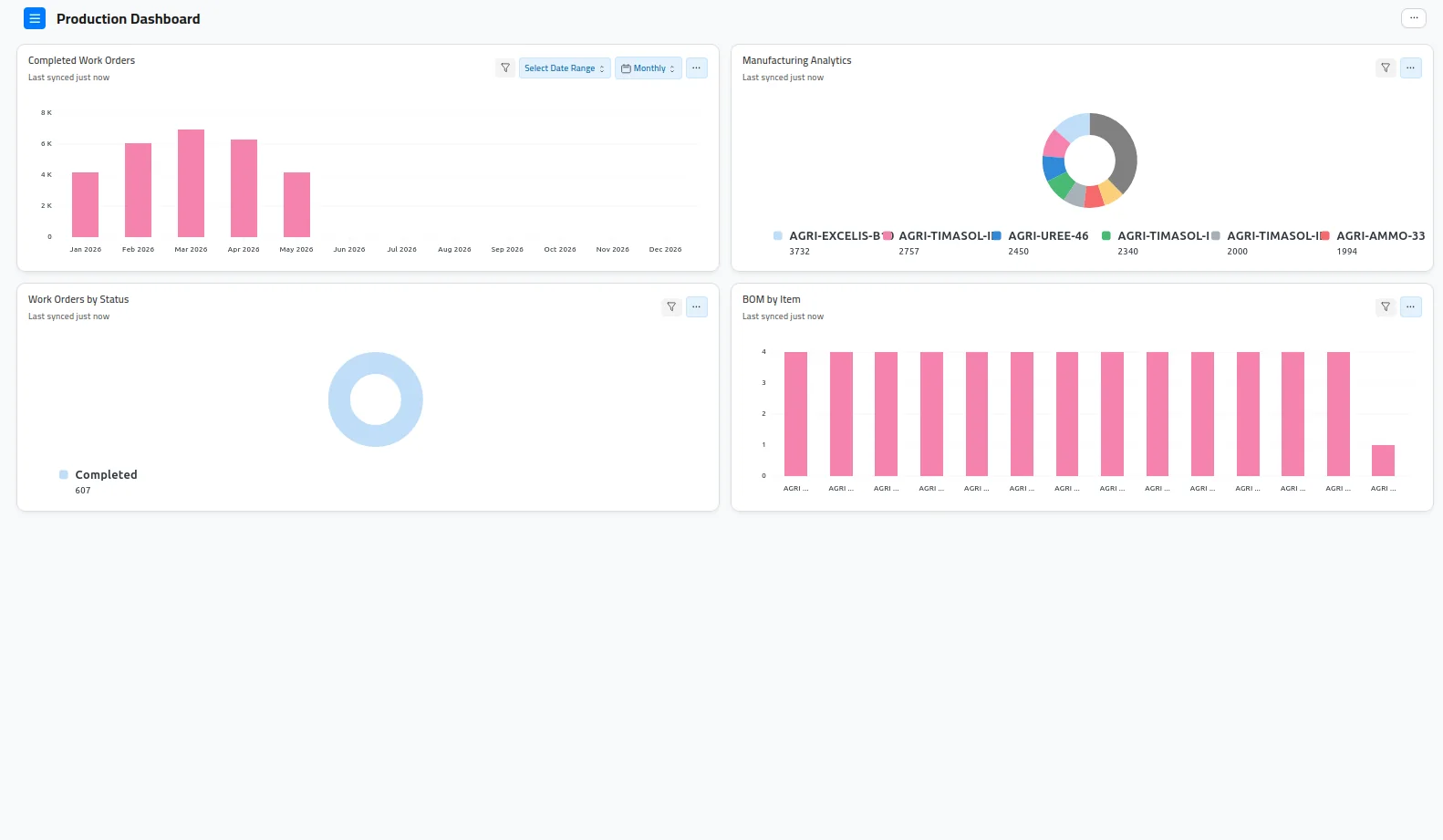
The same application handles production to order, to stock, planned or subcontracted. Work orders start from the sales order when an item has to be made, with the materials reserved, and the production dashboard shows work orders, quantities produced and the bills of materials used.
Reading the margin before you sell
The practical change happens in the sales office. Cost price and margin appear on sales documents, so a salesperson preparing a quote can see what it leaves before the quote goes out. A director who wants to look at a discount reads the effect on the same screen.
This changes some conversations. A low price may still be the right decision, to win a customer or keep a line busy. It stops being an accident, and someone has made that choice knowing the number.
The calculation has to match how you work
Some trades calculate cost in their own way: a specific allocation of overheads, a yield rule, a treatment that belongs to one process alone. FlexiERP is not delivered as standard software, and the company’s own rules and calculations can be built as custom extensions on top of the base. Workshops with each department are where these rules come out, including the ones that have only ever lived in someone’s head.
Any calculation still depends on what it is given. If a bill of materials is out of date, the cost price will be too, so somebody in the company has to own that data. The difference is that an update then happens once, in one place, and every later document reads the new figure.