E-invoicing in Morocco: what changes for your company
What Moroccan law already requires of your invoices, what the DGI has announced for e-invoicing, and how to get your invoice data ready with FlexiERP.
Month end in the accounts office. An invoice went out yesterday as a PDF attachment. The customer calls back: their ICE is missing, and their accountant will not book it. The invoice is cancelled and reissued under a new number, and the payment slips by a week. Nobody made a serious mistake. The customer’s name was typed into a quote, copied into a spreadsheet, typed again into the invoicing tool, and the ICE fell out somewhere along the way.
Today an error like that is settled between two companies over the phone. Under the e-invoicing model the tax administration is preparing, it would surface much earlier.
What the law already asks
The reform does not start from nothing. Since the 2018 Finance Law, article 145-IX of the Moroccan tax code (Code général des impôts, CGI) has required companies subject to corporate tax, to income tax under the real or simplified regime, and to VAT to equip themselves with a computerised invoicing system that meets technical criteria set by the tax administration, the DGI. The details are left to a regulation, sector by sector. Auto-entrepreneurs are excluded.
What an invoice must show is set out too: the seller’s identity and its tax identifier (IF), business tax (patente), ICE and trade register numbers; the date; the buyer’s name, address and ICE; the nature, quantity and price of the goods or services; VAT shown separately, or the exemption that applies; and the payment method with its references. Invoices follow a continuous series, pre-numbered or produced by software. Duplicates of sales invoices and supporting documents are kept for ten years. And an irregular invoice can make the expense non-deductible for your customer, which explains the phone call.
What the DGI has announced
In April 2026 the DGI presented the model it intends to use. It is announced and not yet in force, pending its decree.
Each invoice would be checked in real time by the DGI platform before it reaches the customer, a model known as clearance. It would use a structured format (UBL has been announced) with an electronic signature. Small companies would get a free web portal, while larger ones would connect through their ERP. B2B would come first and B2C later, rolled out gradually, starting with large companies. Later on, certified service providers may also validate invoices. Separately, in its 2025 activity report, the DGI says it has developed a portal to issue, send and receive invoices and to declare what happens after them, such as payments and disputes.
The calendar and the thresholds will be set by the decree. Until it is published, no start date rests on an official text.
What it changes in the office
Under this model the invoice stops being a document you send and becomes data the administration checks. A wrong ICE, a VAT rate applied by hand or a gap in the numbering would no longer be fixed quietly by sending a new PDF: the invoice would be stopped before it reaches the customer.
So the practical question is where the invoice comes from. An invoice retyped from a paper delivery note carries the risk of every retyping. An invoice built from an order and a delivery that are already recorded, with a clean customer record, reuses information that has already been checked once.
Getting ready with FlexiERP
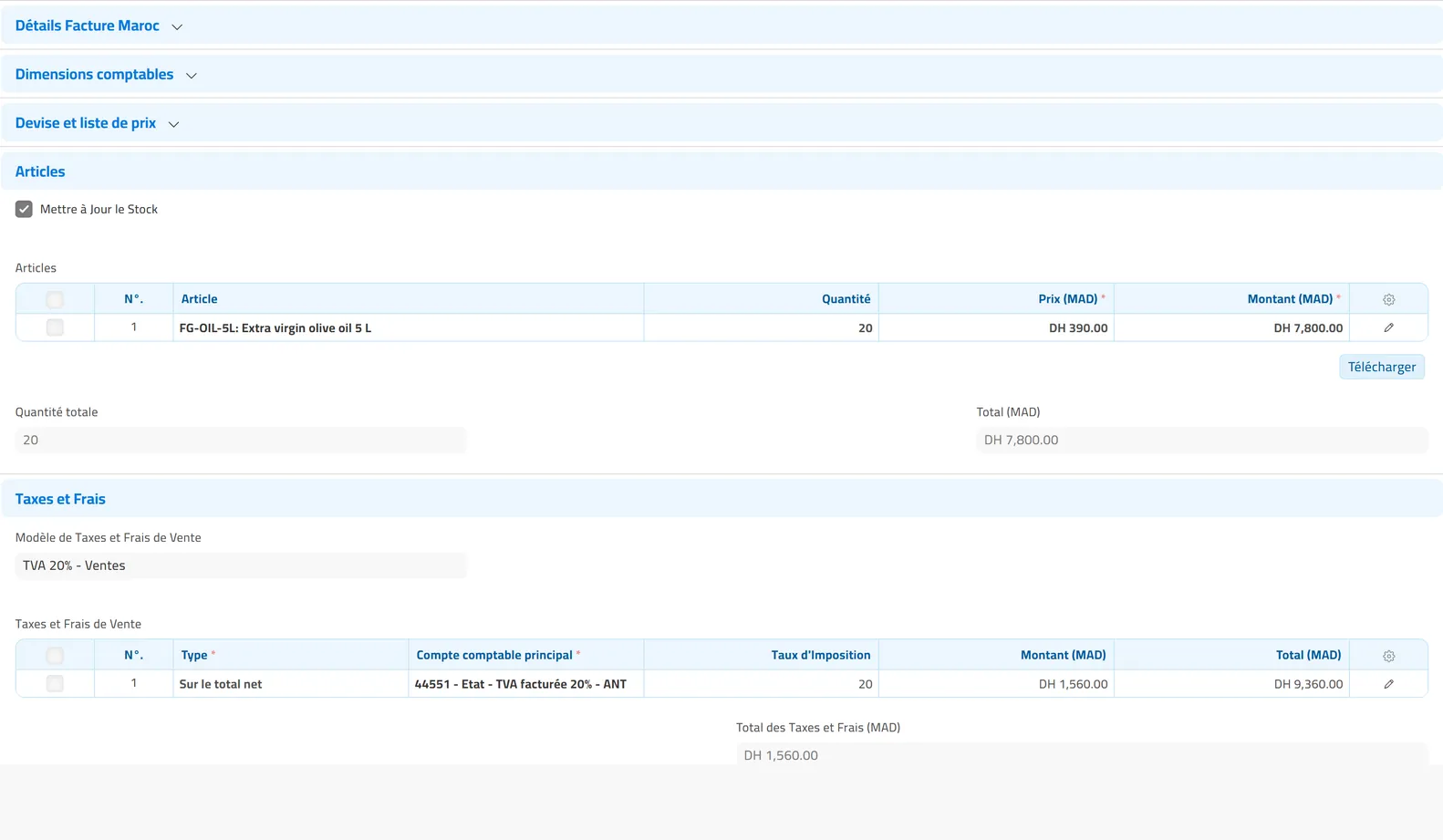
In FlexiERP the invoice is created from the order or the delivery note, and nothing is typed again. Your company’s identifiers (ICE, IF, RC, patente) are entered once in the company record, and the invoice carries its own Moroccan invoice details. VAT comes from tax templates, such as VAT 20 % on sales, rather than from a calculation done by hand. Invoices are numbered in series, and a validated invoice is no longer edited: a credit note corrects it. Every change is traced, invoices and supporting documents stay in the application, and roles and approvals decide who can validate what.
FlexiERP is not delivered as a fixed package, and whatever rules the decree brings can be added as extensions around the core. FlexiERP keeps the invoice data a transmission will draw on, structured and complete, and FlexiGlob sets up the connection with the tax platform as part of the deployment, once the format is published.
In the meantime, the useful work is the part that depends on no decree: complete customer records, clean numbering series, and invoices that start from what was actually delivered.